

Poverty Is Real in Saint Lucia
A briefing in the International Poverty Forum, powered by Caring For Others series.
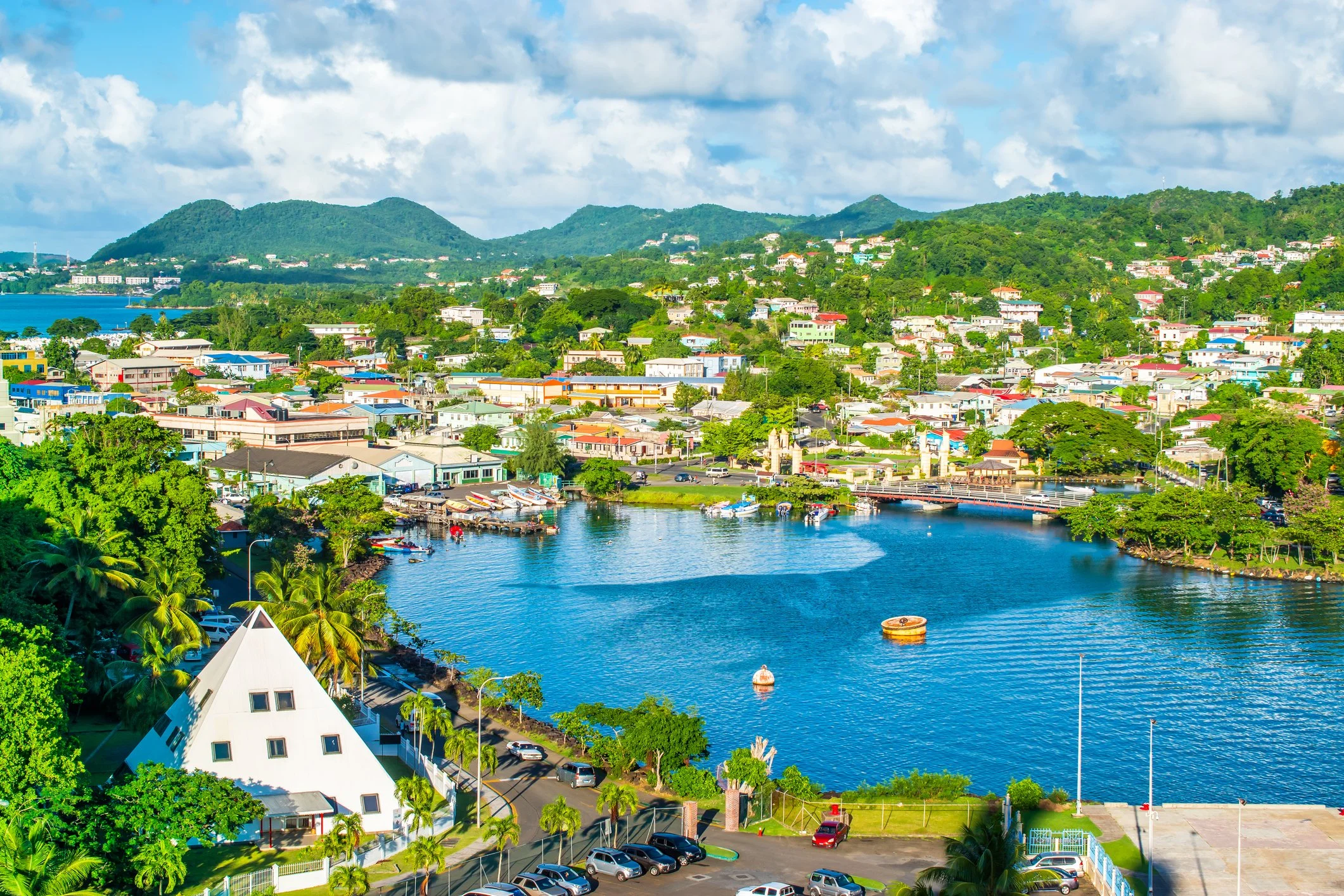
One in four. That is where Saint Lucia's official count last landed — and it landed there ten years ago.
On March 18–19, 2027, the International Poverty Forum will convene its Annual Assembly and Think Tank in Saint Lucia. Before we arrive, we owe our hosts, our delegates and ourselves a clear account of three things: what the evidence actually shows, what has changed since it was gathered, and what nobody can yet answer.
This is the first of those. It is a plain reading of the public record, with every figure sourced.
What the numbers say
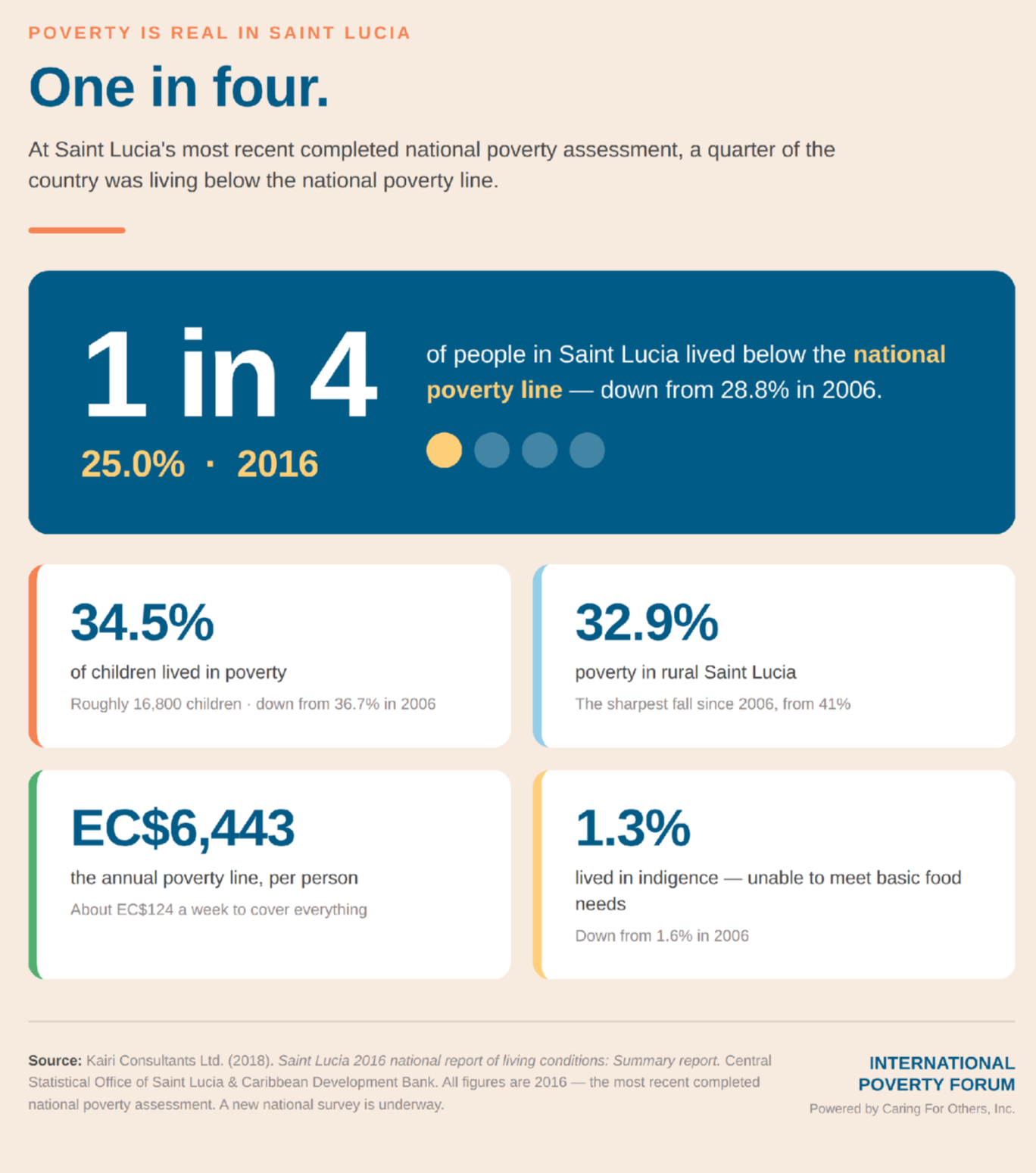
Figures from Saint Lucia's 2016 national assessment of living conditions — the most recent completed count.
At Saint Lucia's most recent completed national poverty assessment, in 2016, 25.0% of the population lived below the national poverty line. That is one person in four. It was an improvement: the same measure stood at 28.8% in 2006 (Kairi Consultants Ltd., 2018).
Underneath that single number, the picture is uneven in ways that matter to anyone planning a response.
Children carried more of it than adults. In 2016, 34.5% of Saint Lucian children lived in poverty — roughly 16,800 of them — against 36.7% a decade earlier. Rural communities carried more of it than towns, at 32.9%, though rural Saint Lucia also made the largest single gain of the decade, down from 41%. And 1.3% of the population lived in indigence, meaning their household could not cover basic food needs at all (Kairi Consultants Ltd., 2018).
The national poverty line itself was EC$6,443 per person per year. That is what one person needed to cover food, shelter, transport, school costs and everything else — about EC$124 a week.
One clarification is worth making, because the two numbers in circulation look like a contradiction and are not. The 25.0% figure is measured against Saint Lucia's own national poverty line, which reflects what it costs to live in Saint Lucia. The World Bank also publishes an internationally comparable estimate, which applies a single global threshold using a different, purchasing-power-adjusted method, and puts the figure below ten percent (World Bank, 2025c). Both are correct. They answer different questions. When we say one in four, we mean the national line — the measure Saint Lucia set for itself.
What has changed since
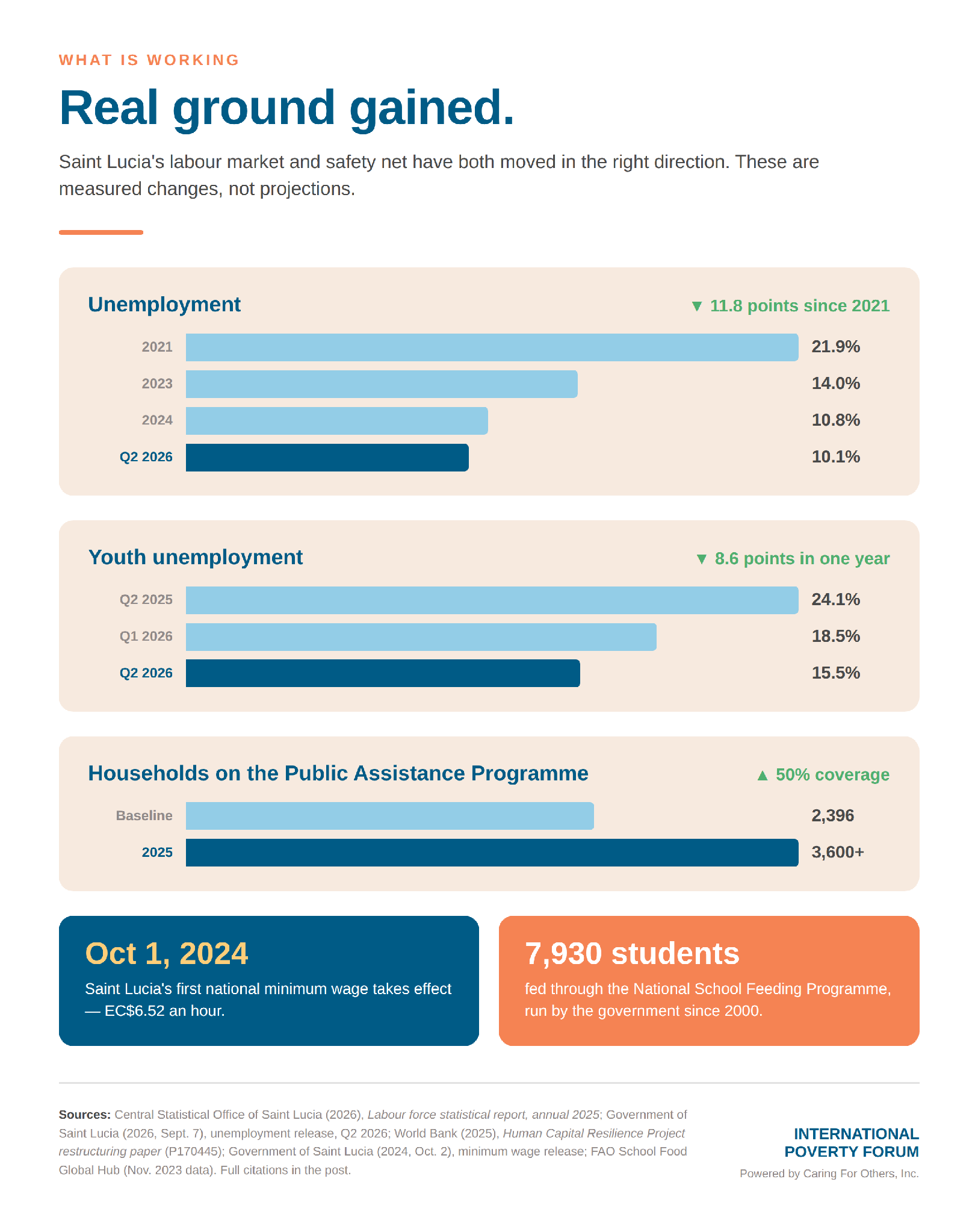
Measured changes in Saint Lucia's labour market and safety net, 2021 through the second quarter of 2026.
The 2016 assessment is the last complete poverty count. It is not the last evidence. Several things have moved since, and some have moved a long way.
Unemployment has roughly halved. It stood at 21.9% in 2021, fell to 14.0% in 2023 and reached 10.8% in 2024 — a level the International Monetary Fund described as a historic low (Central Statistical Office of Saint Lucia, 2026; International Monetary Fund, 2026). In the second quarter of 2026 it was 10.1% (Government of Saint Lucia, 2026).
Youth unemployment fell faster still. It was 24.1% in the second quarter of 2025. One year later it was 15.5% — 8.6 percentage points in twelve months (Government of Saint Lucia, 2026). For a country where young people have historically been the last hired, that is the most consequential number on this page.
The safety net widened. With World Bank support, Saint Lucia expanded its Public Assistance Programme from a baseline of 2,396 households to at least 3,600 — a 50% increase in the number of families receiving regular cash support (World Bank, 2025a).
Two further changes reach households directly. On 1 October 2024, Saint Lucia implemented its first national minimum wage, set at EC$6.52 an hour (Government of Saint Lucia, 2024). And the National School Feeding Programme fed 7,930 students as of November 2023. The government has run that programme through the Department of Education's Student Welfare Unit since 2000, when it took it over from the World Food Programme; meals cost US$1 per child, with socioeconomically vulnerable families exempt from payment (Food and Agriculture Organization of the United Nations, n.d.).
Saint Lucia has also moved to protect those gains from weather. In April 2025 the World Bank approved a US$20 million operation including a Catastrophe Deferred Drawdown Option, which releases money to the government immediately after a disaster rather than months later. Hurricanes alone are estimated to cause nearly US$9.5 million a year in damage to the island's building stock — roughly 0.4 percent of 2023 GDP — and nearly half the population lives within five kilometres of the coastline (World Bank, 2025b).
None of this is a straight line, and we will not present it as one. Overall unemployment rose again in 2025, to 12.6%, driven by a sharp increase among women — from 12.0% to 16.9% (Central Statistical Office of Saint Lucia, 2026). The gap between men and women in the labour market is real and it is not closing. Saint Lucia's Human Development Index has recovered from its pandemic low but has not returned to where it stood in 2015 (United Nations Development Programme, 2025). And growth has slowed: after 4.7% in 2024, the World Bank estimates 1.3% for 2025 (World Bank, 2026).
What nobody can yet answer
Here is the honest limit of everything above: we do not know what poverty in Saint Lucia looks like today. We know what it looked like in 2016. We know the labour market has improved since. We cannot tell you how much of that reached the families who were counted as poor.
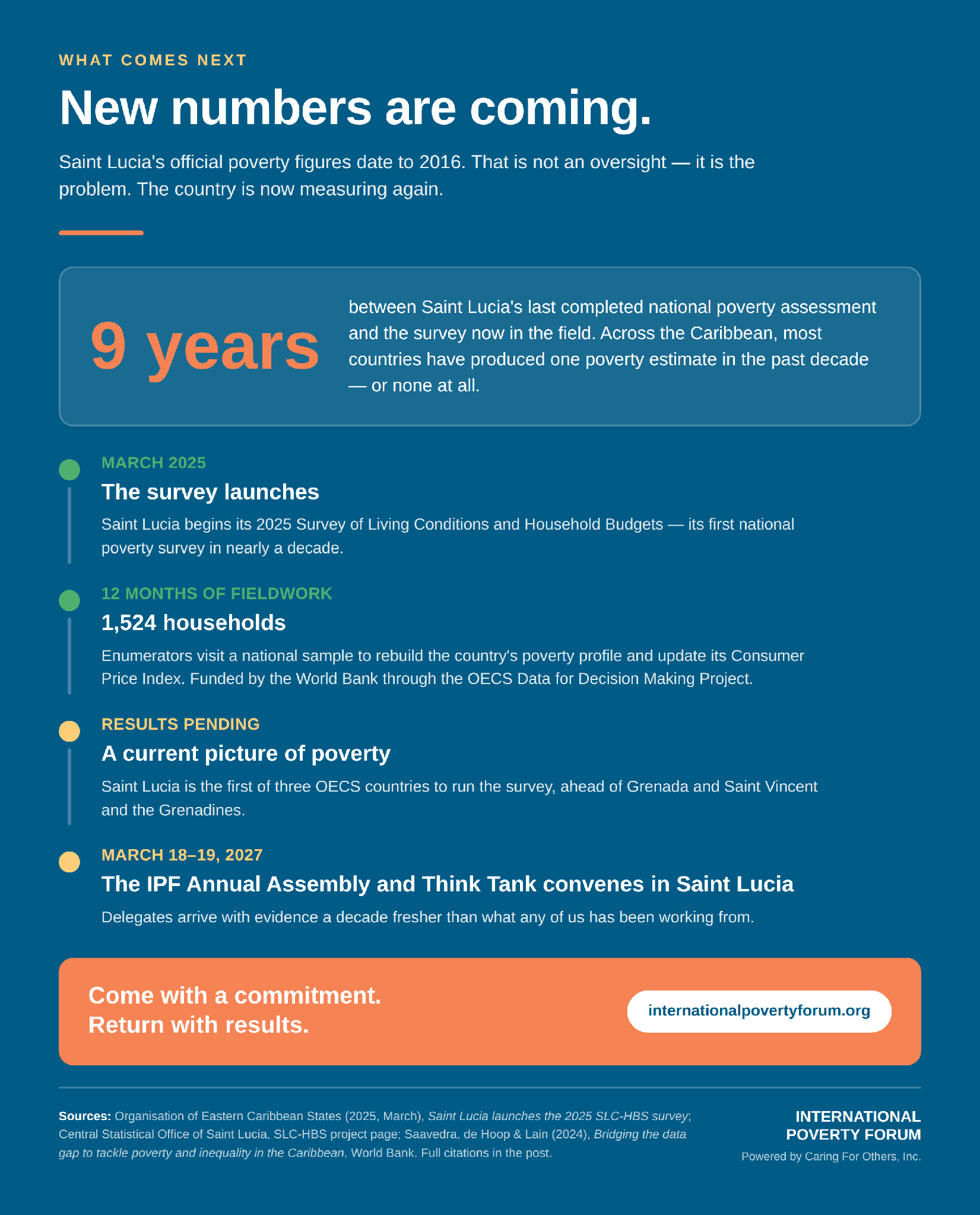
That is not a Saint Lucian failing. Over the past decade, most Caribbean countries have produced a single poverty estimate — or none at all (Saavedra et al., 2024). Measuring poverty well is expensive, and small states are asked to do it with small statistical offices.
Saint Lucia decided to measure again. In March 2025 the country launched its 2025 Survey of Living Conditions and Household Budgets, sending enumerators to a national sample of 1,524 households over twelve months of fieldwork running into 2026. It will rebuild the country's poverty profile and update its Consumer Price Index, funded by the World Bank through the OECS Data for Decision Making Project. Saint Lucia is the first of three OECS countries to run it, ahead of Grenada and Saint Vincent and the Grenadines (Organisation of Eastern Caribbean States, 2025; Central Statistical Office of Saint Lucia, n.d.).
Results are pending. When they arrive, the conversation about poverty in Saint Lucia will rest on evidence a decade fresher than what any of us has been working from.
Saint Lucia's 2025 Survey of Living Conditions and Household Budgets — the first national poverty survey in nearly a decade.
Why we are honored to be going
A country that commissions a new poverty survey is a country willing to be measured. That is not a small thing to volunteer, and it is exactly the posture the Assembly is built around.
The International Poverty Forum does not convene to produce a communiqué. We ask everyone who attends to come with a commitment and return with results. On March 18–19 that room will sit in a country that has cut youth unemployment by a third in a year, widened its safety net by half, put a floor under wages for the first time, and gone back into the field to find out what is actually true. Our hosts are not a case study. They are a partner who has already started the work.
We are honored to be going. Read the announcement below, and come with something to commit.
References
Central Statistical Office of Saint Lucia. (n.d.). SLC-HBS survey. Government of Saint Lucia.
https://stats.gov.lc/about-us/projects/slc-hbs-survey/Central Statistical Office of Saint Lucia. (2026). Labour force statistical report, annual 2025. Government of Saint Lucia. https://stats.gov.lc/wp-content/uploads/2026/05/Labour-Force-Statistical-Report-Annual-2025.pdfFood and Agriculture Organization of the United Nations. (n.d.). Saint Lucia. School Food Global Hub. https://www.fao.org/platforms/school-food/around-the-world/latin-america-and-the-caribbean/saint-lucia2/enGovernment of Saint Lucia. (2024, October 2). Implementation of the national minimum wage. https://www.govt.lc/news/implementation-of-the-national-minimum-wageGovernment of Saint Lucia. (2026, September 7). Saint Lucia's unemployment rate falls to 10.1% in second quarter of 2026. https://www.govt.lc/news/saint-lucia-s-unemployment-rate-falls-to-10-1-in-second-quarter-of-2026International Monetary Fund. (2026). St. Lucia: 2025 Article IV consultation (IMF Country Report No. 26/3). https://www.imf.org/-/media/files/publications/cr/2026/english/1lcaea2026001-source-pdf.pdfKairi Consultants Ltd. (2018). Saint Lucia 2016 national report of living conditions: Summary report. Central Statistical Office of Saint Lucia & Caribbean Development Bank.https://stats.gov.lc/wp-content/uploads/2019/01/Summary-Report-Saint-Lucia-2016-National-Report-of-Living-Conditions_December-2018.pdOrganisation of Eastern Caribbean States. (2025, March). Saint Lucia launches the 2025 SLC-HBS survey. https://pressroom.oecs.int/saint-lucia-launches-the-2025-slc-hbs-surveySaavedra, T., de Hoop, J., & Lain, J. (2024, October 17). Bridging the data gap to tackle poverty and inequality in the Caribbean. World Bank Data Blog. https://blogs.worldbank.org/en/opendata/bridging-the-data-gap-to-tackle-poverty-and-inequality-in-the-caUnited Nations Development Programme. (2025). Human development report 2025: A matter of choice — People and possibilities in the age of AI. https://hdr.undp.org/content/human-development-report-2025World Bank. (2025a). Saint Lucia Human Capital Resilience Project (P170445): Restructuring paper (Report No. RES00159). https://documents1.worldbank.org/curated/en/099042725133533941/pdf/P170445-ff473df3-bc05-47db-8ad3-f9e52eae4f59.pdfWorld Bank. (2025b, April 10). Saint Lucia to strengthen resilience with World Bank support [Press release]. https://www.worldbank.org/en/news/press-release/2025/04/10/saint-lucia-to-strengthen-resilience-with-world-bank-supportWorld Bank. (2025c). Saint Lucia poverty and equity brief: October 2025. https://documents.worldbank.org/en/publication/documents-reports/documentdetail/099655104212523925World Bank. (2026). Macro poverty outlook: Saint Lucia (April 2026 edition). https://thedocs.worldbank.org/en/doc/e408a7e21ba62d843bdd90dc37e61b57-0500032021/related/mpo-lca.pdf